Thursday, December 6, 2007

Jule in Oslo

As a change from the dark and cold of Hirtshals, I decided to spend a week experiencing the darker and colder of Norway. Norway is much more of a cod fishing country than Denmark (my initial choice was for Denmark because of IFM and because I wanted to spend time in more than one EU country so my view of the EU’s Common Fisheries Policy wouldn’t be based solely on one place), and between living just a ferry ride away from Norway and having been talking a lot about Norwegian fisheries implementation through my work with IFM, I wanted to have the chance to visit Norway and hear about some of this myself. Plus, after having been in Iceland, Sweden, Finland, and Denmark, this trip to Norway completes my tour of the Nordic countries.

So Saturday morning, I boarded a ferry (another giant cruise ship ferry like the one I took from Stockholm to Helsinki) headed for Oslo. Oslo is really not much of a place to learn about Norwegian fisheries – the pelagic fisheries are mostly based in other cities in the south (particularly Ålesund), and cod fishing is still mainly considered the domain of the small rural fishing communities in the north. But before heading the rest of the way north to Tromsø, the capitol of northern Norway and hopefully a good place to learn about Norwegian cod fishing, I stopped in Oslo for a few days to see the city.

As it turns out, this weekend was the beginning of advent (not something I usually keep track of), and because of this, everything in Oslo has been Christmas-crazy (or Jule, as they call it here). The entirety of downtown Oslo is decorated with lights and various kinds of Christmas wreaths and trees, special markets and even a temporary ice-skating rink have been set up, and it seems every attraction in town is doing something special for the season.

People shopping on Karl Johans gate, the main pedestrian street in the city center, complete with lots of Christmas sales and decorations. This time of year, it’s dark by 3:30pm, so the lights make it considerably cheerier to be out during the long nights.

This is the Julemarket, set up in a public square by the harbor.

It involved some creative set-up around statues in the square, one in the middle of a display with a train and a nativity scene, and this one surrounded by Christmas trees for sale.

Normally I’m not a big fan of the long commercialized lead-up to Christmas in the US, but even though Norway has plenty of commercialization itself, I have to admit that I like seeing people acting cheery, with streets full of lights and music and people.

Of these many Christmas attractions, however, I’m convinced that I found the best by far: the Julemarked (Christmas market) at the Norwegian Folk Museum. The museum is an open-air museum with a collection of traditional buildings from all over Norway – highlights include an ornately carved and painted stave church from 1200, log house-style storage buildings lofted off the ground, and a collection of traditional crafts: pottery, silversmithy, and weaving – organized into small collections around the grounds. For the Christmas season, the entire museum was decorated in the style of the buildings’ times (not just setting up Christmas trees, which apparently were only popularized in the 19th century after being introduced into schoolhouses and parsonages, but also covering the floor with juniper branches and burning special candles), special activities and demonstrations (carriage rides, sing-along Christmas carols, a concert by a boy’s choir, a service in the 12th century stave church…) were set up around the museum, and the paths were filled by over a hundred stalls of artisans selling everything from Sami-style cured reindeer meat to hand-made textiles to marzipan pigs.

For the curious, apparently it is a Christmas tradition here to eat marzipan pigs. The ones for sale were mouthful-sized, but there was also a giant marzipan pig on display. Traditionally, advent was a lean time because the family had to work hard and forego extras in order to prepare enough food to celebrate on Christmas. But now the whole season is marked by celebration…and indulgence.

Sadly, this also marked the first time this year that I managed to let both of my camera batteries die, and so even though this was one of the most exciting and photogenic places I had seen in a while, so I don’t have many pictures I have to share.

This is one of the open areas with museum buildings grouped around and market stalls set up along the path.

For the children, there was a Christmas workshop where you could assemble your own wooden toys. I didn’t make any toys, but I did play some of the wooden games.

One of the most fascinating crafts on display was lace-making – the woman crossed the bobbins and moved the pins according to a pattern to make gorgeous lace ribbing.

Unfortunately, my camera died before the demonstration I found most exciting of all: a group of young children demonstrating Norwegian folk dancing. They were dressed in traditional costumes: the boys in pointy red hats (like elf hats) and black suspender-trousers, the girls in floral patterned headkerchiefs and black suspender-skirts with green and red stripes, both boys and girls with faire isle patterned sweaters and freckles painted on their faces…and, oh my, dressed up children folk dancing is about the most adorable thing imaginable. It was really fun for me to recognize a lot of the dances (Norwegian and Danish folk dance are very similar), including a surprisingly well-executed schottis with lots of fancy twists. Norwegian folk dance also includes a number of male-only dances that are designed to pantomime demonstrations of machismo, and four of the boys did a hilarious dance that involved synchronized staring each other down, slapping each other in the face, and showing off their biceps. As part of the demonstration, they also invited Santa (Nisse)* on stage to dance with some of the girls, who were obviously thrilled to be dancing with Santa.

As with any living history museum, it didn’t entirely recreate authentic Christmas traditions from the past (the service in the 12th century church, for instance, was led by a woman), but the modern tradition of going to the Julemarked at the Folk Museum is definitely popular in Oslo (it was full of people from open to close) and it was exciting to see the ways in which Norwegians celebrate their folk traditions. I was able to sample some of the traditional Norwegian Christmas foods – a Christmas bread (sweet, with spices and raisins) and lefse – a flat potato-based bread – made in the traditional style over hot ashes in one of the old wooden buildings. I did not, however, get to taste the traditional Christmas cod served with lefse: it’s called lutefisk, which translates as lye fish and is made by soaking dried cod (stockfish) and mixing it with ashes (lye) until the proteins break down and it gains a jelly-like consistency. (I must admit, that my curiosity about this Norwegian cod specialty is tempered by severe doubt that I would actually enjoy it – if I do try it, I’ll let you know.)

On Sunday, I set off on a less Christmas-y adventure to see Oslo’s famous sculpture park containing hundreds of sculptures by Gustav Vigeland.

Vigeland himself, in front of the café at the entrance to the park:

Originally in 1907, the City of Kristiania (Oslo, renamed in honor of himself by King Christian IV for a period of a few centuries) just commissioned Vigeland to create a fountain for the city, but the fountain became just the starting point for an entire 80-acre park lined with sculptures of human figures. I was really struck by the realism and human emotion in the statues, and enjoyed wandering around the park for a few hours. It’s a really nice part of the city because in addition to attracting tourists, it also was full of people running, walking their dogs, even a group of preschool children. It’s nice for people in Oslo to be able to spend an afternoon out going for a nice walk past such fabulous sculptures.

It was mostly fairly calm and quiet in the park, but the addition of a street musician with his accordion (common on the streets of Oslo at least while I was there) added a little more life to the park on a quiet Monday.

On the way back from Vigeland’s park, I still had some more time to spend, so I got off the tram near the harbor to wander around and eventually found my way to the Akershus Fortress, which has defended Oslo for 700 years. Even though the fortress itself is no longer serving much of a defensive purpose, it’s now used as a base for the Norwegian military (mostly, it seems, as a location for training schools).

First I wandered around the fortress for a while…

And then headed to the 13th century Akershus castle (although since it was remodeled in the 17th century it looks more like a renaissance castle than true medieval style).

And of course the castle, like everything else in Oslo, was decorated for Christmas.

The castle provided a good view of the fortress’s defenses outside,

But really the best part was the view from the fortress of the sunset over the fjord. Scandinavian light really is something special, and this view was gorgeous.

It may be dark here a lot of the winter, but between the pre-Christmas excitement and the colors in the sky when it is light out, it still feels very welcoming to be in Norway in the winter. I like it here.


*Santa Claus was not part of the Norwegian Christmas tradition until fairly recently, and so they have adopted the term nisse for Santa even though nisse really has no proper translation into English. They look like some variation on elves or trolls, and a major symbol of the Christmas season, filling stores in Norway (and in Denmark). I still don’t have a proper translation, but I’ve decided to call them gnomes based on this discovery in a bookstore in downtown Oslo.

The English version, of which I am rather fond, is called simply Gnomes.

Sunday, December 2, 2007

The Sand Tour

The most adventurous of my Thanksgiving week adventures with Michelle was going on the “sand tour” to see northern Denmark’s sandiest attractions. To most people out there (although maybe not the geologists), sand does not initially seem so exciting…but since this northern tip of the country is full of large, rapidly migrating sand dunes, there are a lot of nifty places where you can see how the sand has moved over recent human history. As a geologist, I’m used to thinking about the earth and landforms changing drastically over time, but it’s not often you can see so plainly how much the land has changed on a human time scale. Apparently IFM used to take visitors on this regional “sand tour” to see some of the most interesting sights in the area, and Doug (one of the researchers here) offered to take Michelle and I on this tour.

We started south of Hirtshals at the Mårup Church, which is notable because erosion on the western coast of Denmark including near this church is slowly bring the church close to falling into the North Sea. It didn’t seem too much in danger of falling in while we were there, but there is already a little chunk that has been reclaimed by the sea.

Since there are a lot of churches in Denmark (each little town has its own), it makes sense that there would be lots of churches succumbing to the sand movements in the changing landscape. At the end of the day, after we drove north to Skagen, we saw another church that is literally half buried in a sand dune – the part you can see sticking up above the sand used to be the tower above the main portion of the church that also extended further back and is now completely covered. (Although I must admit, you couldn’t really tell that the exposed part wasn’t the whole church, and we joked that it would be a pretty good prank to build part of a church, bring in some sand, and then say it had been buried by a sand dune so you could call it a tourist attraction.)

Doug told us that the Danes have actually spent many years debating what to do about these churches and other landmarks threatened by the moving sand dunes. Options include everything from trying to prevent erosion a la Jersey shore (not an attractive idea) to moving the building to a safer location either close nearby or in a collection of historic buildings to just letting it fall into the ocean as the erosion continues. Denmark has in the past managed some rather impressive changes to combat the problems of sand erosion, mostly after deforestation left the soil vulnerable and massive labor forces had to be generated to plant new trees and try to revitalize the soil (they plowed almost all of Denmark’s soil with lime to increase the pH)…but it seems as if in the case of the Mårup Church it’s mostly talk and they’ll probably still be talking until the church falls into the North Sea.

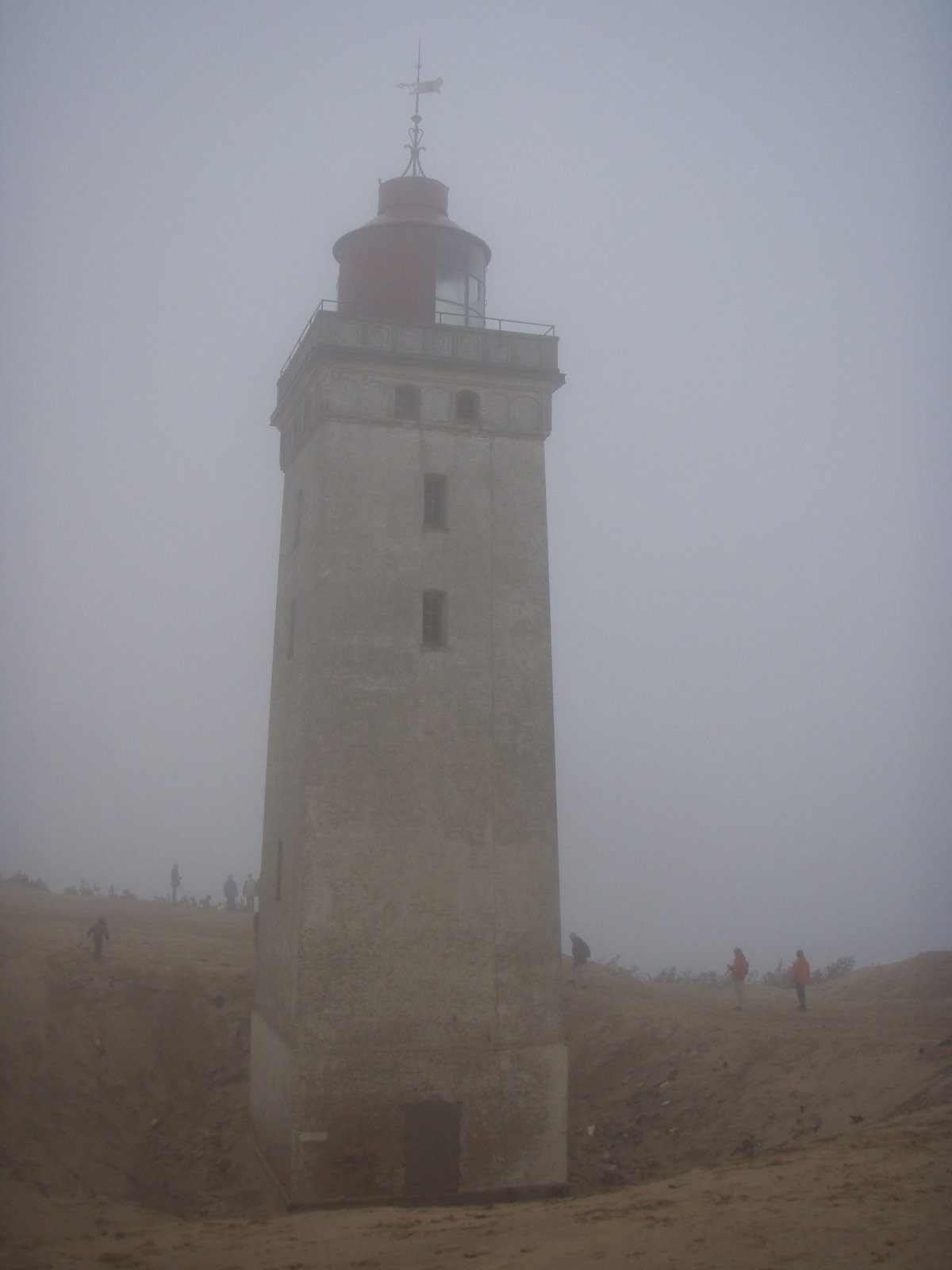
Sand burial, however, has made some cool places for exploring. The best by far was the Rubjerg Knude Fyr, a lighthouse near Lønstrup (slightly south of Hirtshals) built in 1900 that was taken out of operation in 1968 due to the sand drift. They’ve stopped trying to fight the sand and predict that the lighthouse will be entirely buried within a few years, but for right now, it’s still sticking out of the top of the dune. It’s a big dune – big enough that sand sledding has become fairly popular on the side of the dune here.

It was a really foggy day, which was unfortunate for the view (which is apparently spectacular), but made for quite a surreal sight when we finished scrambling to the top of the dune.

And – even cooler – although technically the lighthouse is closed to visitors, there’s a window that hasn’t been boarded up at the current ground level where you can crawl in. So, of course, we did.*

First we went into what must have once been a side building attached to the main lighthouse tower, now just a small space between the tower and the dune outside.

And then crawled through into the main lighthouse itself.

And then climbed up. Despite the lighthouse being significantly filled in with sand, it was still a long way up.

After a few flights of stairs, we got to the light itself…but still not the top. That was another flight of stair still, to the lookout area.

It was too cloudy to see all the way along the coastline the way I hear you can on a clear day, but it was still neat to stand at the very top of a lighthouse in a sand dune looking out at the North Sea.

Our next stop was not sand-related, but Doug told us that it was important that we see a “typical Danish menagerie.” I wasn’t quite sure what to expect, but I definitely wasn’t expecting this in Denmark.

A local artist made all of these concrete-wire-industrial parts sculptures, and though everyone thought he was kind of nuts while he was alive, the town discovered that they were curious enough pieces to make a sculpture garden that attracts tourists, so now northern Denmark advertises this odd menagerie as a place you should see when traveling in the area.

The last stop on the sand tour combined sand and wildlife. All the sand that’s been eroding off the west coast of Jutland has to go somewhere, and that somewhere is to the very tip of the country at Skagen, which has been gradually extending over the years as the sand accumulates. This was vividly illustrated as we drove past a succession of four lighthouses that have marked the tip of Denmark over the years: the first we passed was a reconstruction of a 17th century wooden crane-looking apparatus which held a fire in a bucket (you can see a picture and a better description here), which was followed by three other progressively more recent lighthouses we passed as we drove north. Even the one currently in use is a decent ways back from the current tip of the land – this is the view of the lighthouse just after dusk looking south from the current end of the sand.

Which means…I’ve actually been to the very end of Denmark – walked out along the sandy spit called Grenen at the tip of the country that divides the Kattegat and the Skagerrak and marks the entrance to the Baltic Sea from the Atlantic. Michelle walked out to the end, which does not look as momentous as it seems it should be.

More momentous, however, was the wildlife. The graffiti on the concrete building near the parking area advertised an impressive array of birds.

We didn’t spot any more exciting birds than gulls…but we did find a baby seal lying on the shore.

I like to think that its mother came back for it later, but chances are it was abandoned – although the abandoned seals usually cry, and this one wasn’t making any noise. There are apparently too many seals in the North Sea for them to be rescued by aquaria when they’re found stranded (the North Sea Museum says that if you find a baby seal you can call them and they’ll “put it away”), so there wasn’t really anything to do for it. But I felt pretty bad for this little seal out on the shore on a cold, foggy day with lots of people coming along and to take pictures of it…moral of the story: if you’re a seal mother and going to abandon your baby, at least find somewhere not full of tourists.


*For my worrying relatives, this was not a terribly risky move. Despite the lighthouse technically being closed to the public, there was a steady stream of people crawling in and climbing up. I suspect it’s technically closed because there’s nobody officially in charge of maintenance, but if they actually thought it was dangerous they’d probably close up the entrance.

Wednesday, November 28, 2007

A Very Happy Thanksgiving

First of all, I do realize that Thanksgiving was last week, and I apologize for writing so belatedly to wish happy food-eating to those who have not yet given up on reading this blog. Also, many apologies for the long hiatus between posts. Somehow I neglected to realize how many things I’ve forgotten to write about, which I will attempt to remedy soon. Anyway, despite being an ocean away from the US, I had a lovely Thanksgiving here in Denmark, which was particularly exciting because I had an American visitor, who came bringing happiness and light and also pumpkin and cranberries.

Michelle with our real made-in-Denmark pumpkin pie:

Also, for good measure, here is a picture of me with our pumpkin pie. Note the adjacent bowl of whipped cream and be sure to compare the relative volumes of the whipped cream and the pumpkin.

We didn’t have a Thanksgiving dinner on Thursday (although we did make pumpkin soup, which felt rather celebratory to me), but on Friday, a collection of Americans (and one Norwegian woman who had lived in Texas for seventeen years) living in Vendsyssel-Thy gathered at the guesthouse to have a sort of haphazard potluck Thanksgiving dinner. It wasn’t exactly traditional, but we made mashed potatoes and cranberry sauce and apple crisp and other people brought a rather large amount of other foods including a duck. We even talked about American politics, which I guess tends to happen on the few occasions when a group of Americans living abroad gather together. (I can only imagine the discussions here on the 4th of July when the Americans gather to celebrate at a park in northern Denmark - northern Denmark holds the distinction of being the only place outside of the US to publicly celebrate America’s Independence Day).

We also managed to have a number of adventures outside the kitchen (although the cooking was a lot of fun too). These included spending an afternoon talking with one of the few inshore fishermen who has not left fishing under the new quota system in Denmark and who (mostly unsuccessfully) attempted to introduce us to a very strong Danish schnapps with wormwood (a “medicine”), learning a card trick from a very outgoing and excitable man on a train who introduced himself by comparing our rummy rules rather unfavorably with those he usually uses, and a successful expedition in the local timber production forest to meet some Danish sheep.

We were very excited about the sheep (this, for those of you unaware, because Michelle and I share a grand scheme for life that involves having our own sheep and goat farm).

There were also a number of other adventures, but these deserve posts of their own, so you can look for some more regular updates here coming soon!

Monday, November 5, 2007

A Changing Climate

I was a little surprised to discover a comment on my last post asking about the relationship between fossil fuel dependence and commercial fisheries - I was mostly surprised to discover that people other than my friends and family are reading this, but I was also surprised because it's something I've been thinking about as one of the long-term considerations for fisheries but is currently only a sideline discussion in most current fisheries management discourse. But that doesn't mean it's not being talked about - it just means it comes up in ways that, at least for me, have been rather unexpected. Energy use has become an increasingly common topic within the fishing industry as fuel prices have increased, but most of the time (though there are exceptions) this discussion is completely separate from any discussion of climate change. And awareness of global warming doesn't necessarily increase conservation tendencies - there haven't been any definitive studies on how changing climate will affect fish stocks, though it seems pretty much assured that the fish behavior and populations will be affected. This leads to a tendency (which may or may not be justified) to point to climate change rather than overfishing as an external environmental factor that is causing declining fish populations, and I also heard one criticism of the "precautionary approach" to fishing aimed towards rebuilding stocks saying that it would be a better idea to catch the fish while we can since there's always a chance they'll disappear anyway due to climate change.

The first major discussion I heard about commercial fishing's fossil fuel dependence was at the ICES science conference in Helsinki. One of the many "theme sessions" was entitled "Increasing energy costs and impact on fishers' activities and economics - another challenge for fishers and managers." This title is indicative of how most people within fisheries talk about fossil fuel dependence: it's all about costs. Just as Americans back home are slowly starting to take hybrid cars more seriously as the gas prices skyrocket, the fishing industry has started taking notice of their extensive energy use because paying for fuel is taking a large chunk out of already unpredictable profit margins. The research presented at ICES looked at a number of interesting possibilities to decrease fuel costs - running engines on bio-diesel (works in research setting, but largely impractical due to difficulties of attaining a regular fuel supply), changing fishing practices to reduce the amount of energy used steaming to fishing grounds (either by switching fishing grounds or going slower to use less fuel), or switching from energy-intensive active fishing gear like trawl nets (it takes a lot of engine power to drag a heavy net full of fish across the seafloor for an hour) to passive gear like hooks or gillnets.

What I found most surprising, though, was that I was in a room full of researchers at a science conference talking about reducing fossil fuel use and nobody was talking about climate change. Now maybe the world of professional science is so used to hearing about climate change that this was in the back of everyone's minds, or maybe I've spent too much time among environmental groups trying to convince Americans to do something about climate change that I always feel the need to connect energy efficiency and climate change, but I kept waiting for someone to mention how these changes would be the equivalent of taking so many cars off the road or at least save some Kyoto quota to use somewhere else. I suspect this is largely because it seemed unnecessary to mention and rather outside the purview of the fishing industry, the real target of this research.

I do agree that cost savings is indeed the easiest way to sell energy efficiency is cost savings to the fishing industry. Apparently 50% of the fishing quota value in Belgium goes to paying fuel costs for its beam trawlers (a very intensive fishing method requiring a lot of energy, also the dominant gear type in Belgium), which even if you don't care at all about climate seems like a pretty important issue. But I think it's also possible to use energy efficiency as a marketing strategy to help both increase the market prices of fish sold to the environmentally-conscious consumer, particularly since fishers and fish sellers have found it difficult to pass energy costs along to consumers - in supermarkets, fish pricing has to be competitive with pricing for chicken and other food alternatives (this is also another argument for looking at sustainable food supply as a whole). The commercial fishing industry has gotten a bad reputation as environmental villains which, despite legitimate problems with overfishing, is largely undeserved and the industry is working very hard to change. It might not work everywhere, but specially marketing fish as caught with a boat powered with bio-diesel or even just a boat that has altered its fishing practices to increase energy efficiency probably would sell more fish.

Marketing fish as "sustainable" has become increasingly important, particularly through independent certifications from the Marine Stewardship Council, and everyone seems to be trying to show that their fish is good for the environment as well as good for you. Even here in northern Jutland, supermarkets are advertising their fish with eco-friendly labels from WWF, which supports MSC labeling, despite the fact that the MSC has recommended against buying North Sea cod.
Apparently, environmentally-friendly sells - and as of yet, the market on fish that are green because they were caught using less fossil fuels appears to be open.

I had what I initially thought was a brilliant (and now think is probably just crazy, but still fun) idea during the ICES presentations that a really great way to market fish would be to develop a small-scale fishery using the most energy-efficient fuel out there: wind. The presenter I asked about this seemed a little taken aback at the suggestion - he mentioned that a German company has developed a sort of parachute sail that can be used to augment engine power in some situations, though he didn't seem very optimistic about its potential to be used on a large scale. But I wasn't thinking of parachutes...I was thinking of a good old-fashioned sailing schooner. Again, I don't know how effective this would be as a marketing strategy, but I thought it would be really cool to operate an historically-based fishery using sailing vessels and hook or longline passive gear - it preserves history and preserves the environment...so there must be someone out there who would pay extra for fish caught like this. You could also run the operation as a sort of museum, which could help support a small fishing town that has been forced to diversify away from fishing (I'm thinking of the role of the Herring Era Museum in Siglufjörður, Iceland). Obviously this is not something that could work on a large scale throughout an entire fishery, and I'm probably running away with myself because I have an overly-romantic attachment to old sailing boats, but it's still a fun idea.

But I digress.

There are some people here talking about climate change and fishing practices. At the North Sea Regional Advisory Council (NSRAC) meeting a few weeks ago, I met Knud Anderson, who represents the Danish Society for a Living Sea on the NSRAC's General Assembly (there was also a rather politically-charged debate on the technicalities of whether he could gain a seat on the more influential Executive Committee which ended with nobody, including Knud, being quite sure whether anything had been decided). Knud, a former fisherman, has turned his fishing boat into a traveling exhibition for a campaign to reduce energy use in the fishing industry.
The slogan on the banner means "Sea and climate - change the course." I'm not sure whether he has much chance of making headway among the fishing industry or affecting fishing policy - arguing for less energy use is largely a matter of arguing for smaller coastal fishing vessels rather than larger industrial-scale trawlers, which is not terribly popular among the large vessel operators who are becoming increasingly dominant in the industry (which, though he doesn't talk about this directly, makes this an issue that divides the business-driven model of fishing that seeks to make the industry profitable from the lifestyle-based model of fishing that dominates in floundering coastal communities).

I've been convinced for a while, though, that environmental issues (and often other issues too) should not be dealt with in isolation but rather should be considered as part of an interconnected whole (jury's still out on how to do this well, but ignoring relevant issues as "beyond our scope" seems like a bad idea). Knud has been arguing against following the MSC recommendation against North Sea cod, arguing that the labeling scheme doesn't take into account the low energy (and also lower environmental impact) fishing methods used by some of the local fishermen. In a speech in August, Knud said, "And when I...ask: 'Why is the fuel consumption in relation to the catch not taken in as a parameter in this Eco labeling, in a situation with the great threat from the climate changes?', then the answer is, that you should not mix the climate problems with the consumer’s choice of fish. The energy problem has to wait, the people from WWF believe. Our opinion in Living Sea is that such an approach is the same as giving up on environmental politics altogether!" I'm not sure whether I have much confidence he'll make headway, but I think he has a point. I haven't quite figured out my master plan for how to solve all the world's problems together, and it's probably not possible to implement one master plan all in one go, but it would definitely be a mistake not to consider fossil-fuel dependence and climate change in developing long term fisheries policy.

Friday, November 2, 2007

The Vegetarian's Dilemma

One of the things that people have found most strange about me and my travels - second only to asking why a girl from Pittsburgh (after, with furrowed brows, they recollect that Pittsburgh and indeed all of Pennsylvania are quite decidedly inland locations) is studying fishing - is that I don't eat meat. While the concept of vegetarianism has become fairly common in the US and particularly in liberal western Massachusetts, it is fairly unusual in Iceland and Denmark. The lead scientist on the Icelandic shrimp survey seemed positively appalled that I had not tasted Icelandic lamb, and I've been able to redeem myself from my meatless oddity among quite a number of fishermen only because I still eat seafood. I've been thinking about food choices a lot recently, spurred partly because of this response and partly because an inherent question for me in studying fisheries is thinking about how fish fit in with overall food supply. After writing about the question of lobsters and ethical eating, I bought a copy of The Omnivore's Dilemma by Michael Pollan, which has started me thinking much more coherently about that basic question he begins with: What should we eat for dinner?

The book is basically a personal journalistic investigation of the US food supply, in three separate sections - first, the industrial food supply, following government-subsidized petrochemically-fertilized midwestern corn through CAFOs (Concentrated Animal Feeding Operations) and processing plants to a McDonald's meal, then moving on to the organic food movement, both the large-scale "industrial organic" Whole Foods variety and the small-scale local and self contained "beyond organic" farm, and ending with an odd but interesting experiment in foraging for a meal by hunting and gathering the ingredients in Northern California. The first section on the critical flaw of oil dependence in America's industrial corn production and meat-producing industry is sufficiently shocking to rival the century-earlier exposé in Upton Sinclair's The Jungle (and Pollan's writing style is far more enjoyable), and the investigation of how "organic" has come to mean something more like "a little bit better for the environment" than "actually sustainable and environmentally-sound" is an important reminder to people (myself included) who like the idea of picking up "free-range" eggs or "organic" milk and thinking no further. By the end, the book becomes less a journalistic investigation and more a personal exploration (both actual and philosophical) into questions of food source and choice. Though I definitely recommend the book to anyone who has ever tried to decipher supermarket labels, it by no means is the definitive source on food in America. It has gained a lot of publicity, and as a result also a fair amount of criticism that it doesn't live up to its purported excellence, but I think what's most important about it is that it encourages an honest, thoughtful investigation of where our food actually comes from. As a friend of mine who knows far more about food and has seen much more of the non-American world than I have just wrote about on her blog, the US is singularly unaware of how food gets to our tables.

For me, the question of why I don't eat meat surfaced again and again throughout the book. If anything made from standard subsidized and fertilized corn fields is contributing to climate change by demanding petrochemically-derived fertilizers, water pollution from excess fertilizer runoff, and perhaps even the US's oil-driven military exploits, I would probably do better to swear off high fructose corn syrup (i.e. every sweet processed food) than Icelandic lamb, which converts grass, a nutrient-supply humans can't digest, into the meat that has sustained Iceland for generations, and is the ultimate free-range animal - the farmers set them lose to the mountains in the spring and don't gather them again until the fall. Iceland in particular, and also to a large extent Denmark (and most of Europe), have very different food supply systems than the US. In Iceland, it is arguably much more sustainable to eat animal products grown off of the land that is not capable of producing crops humans can eat directly than to import food from all over the world or eat fruits and vegetables grown in greenhouses. Denmark, though less drastically different from the US, as a whole treats its animals better than a US CAFO - my milk, for instance, comes from right here in Hirtshals, and I see the cows grazing in the fields when I ride my bike along the coast.

The Icelandic sheep I failed to eat. They have a pretty good life, grazing along the coastline in Vestmannaeyjar in pretty much one of the most beautiful places I've ever been.

My problem with eating meat is not in the concept of using an animal for food - I want to treat animals humanely and I want to generally eat sustainably, which in part of my reasoning against eating meat means eating lower in the food chain, but grass-fed animals that are raised on farms that treat the animals well (as the farmer Joel Salatin says in Pollan's book, letting a chicken act like a chicken) seem like an acceptable and yes, even sustainable, part of a balanced diet. My problem is that I only want to eat meat when I know where it came from, how it lived, and how it was killed. My eventual questioning of where meat comes from eventually brought me to deciding to call myself a vegetarian, which I consider more of a precautionary convenience than a philosophy. When I first began eating in a college dining hall, I quickly stopped eating the meat there, more for quality than for ethics (I ate various fried versions of chicken for a while until I realized that just because it seemed more appetizing because I couldn't see the meat didn't make it any better), and soon I was only eating meat at Hillel's kosher Friday night dinners and when I went home over breaks. After discovering that it was possible to go months without eating meat, it was easy to start asking myself why I was eating it at all. For a while, I limited myself to kosher or "organic" and "free-range" meat, but it wasn't a very convenient way of eating - one of Pollan's critiques of vegetarianism is that it inconveniences others, but I've generally found that it's more polite to simply label myself as a non-meat-eater than to ask a slew of questions about whether a cow was kept inside in overcrowded pens and how it was slaughtered before sitting down to a meal. For a while after I had essentially stopped eating meat, I resisted the term vegetarian, which tends to imply a much more determined anti-meat philosophy than I actually hold, but it similarly makes for a much more awkward conversation to try to explain my nuanced views on eating meat than to just tell someone I'm vegetarian.

But ideally, it should be possible to change the way food is produced so that I wouldn't find it necessary to not eat meat - which, as Pollan points out, does not mean I'm eating food that is any better for the environment. Changing the food production system in the US to a more integrated, more "natural" system that uses energy and resources more efficiently by recycling waste (manure as fertilizer, pest insects as food for chickens, etc.) and avoiding non-renewable energy inputs would make food more expensive, but also reduce the overall costs to the economy (from farm subsidies to healthcare costs brought on by unhealthy diets to the many costs of oil dependence). This is one of the few arenas where it is possible for individuals to really change society, since everyone has to get food from somewhere, and choosing food from local, sustainable sources has the added benefit of being not just good for the environment but good for your health and usually a whole lot tastier too.

In the mean time, though I've sometimes questioned whether I should keep eating seafood when it's often not caught from sustainable fish stocks or from low on the food chain, the fact that much of the world's seafood supply still comes from wild stocks "hunted" by fishermen seems an important reason to keep eating seafood. Though most people don't know where their food comes from, when living in a fishing community, seeing the boats in the harbor, and sometimes even buying your dinner directly from a fisherman coming back to port at the end of the day, the connection isn't quite so distant. And, much the same way grass-fed animals take a resource we can't eat and turn it into something we can, most wild-caught fish are taking resources people can't (or won't) eat - algae, krill, small crustaceans and fish - and turning them into something we can. Though it is certainly important to make sure we don't catch too many fish to keep them from being able to replenish the population, fish are one of the few foods we have left where we regularly remember to think about where they come from, and that the answer is from nature and not from the supermarket. (This is also part of why I find it ridiculous to suggest that a more "sustainable" way of eating fish is to substitute wild with farm-raised fish. Although it's too complicated to go into here, like in agriculture, there are a variety of methods of raising farmed fish that determine whether the operation is good for both the fish and the environment. The context, however, is far different from agriculture, both because of the difference in the ocean versus terrestrial environment and because we have not yet domesticated fish. I suspect that this suggestion is based on the false conceit that the ocean is some kind of "last wilderness" that we must preserve rather than recognizing that the ocean's ecosystems, like the rest of the world, have been profoundly affected by human influence.)

These cod were brought to the dock on the fishing boat that had caught them that day just the night before I saw them sold at the 7am fish auction in Hirtshals. And if that's not fresh enough for you, some people go down to the docks and buy the fish directly from the fishermen right as they pull into the harbor.

Right now, fish are the only animal I eat as food because I know where they come from and how they got from the ocean to me (also because they're the only animal I've killed myself, which I'm fairly sure I will have to do before I could go back to eating any other meat). But it doesn't have to be that way, and I like to think that if people start asking about their food before they eat, sustainability can become a more natural part what goes through our minds when we go to the grocery store - and thus also a more natural part of what goes into deciding how to produce our food.

Sunday, October 28, 2007

Vendsyssel's Hell's Angels

Yup, that’s right – there are bikers in Denmark. When most people think of biking in Denmark, they think of stately Scandinavians in business dress and pea coats peddling their way to work through the streets of Copenhagen. And while bicycles are indeed ubiquitous here – Copenhagen apparently has the highest rate of bicycle use per capita of any city in Europe and there are spaces for bicycles on all the trains – the kind of bikers I’m talking about are the real biker dude type that you imagine zooming around highways in the good ol’ American west. I heard my first story about the Danish Hell’s Angels a couple weeks ago as an explanation of the rather rough fishing crowd in Hirtshals – apparently the bikers, who came up north for the weekend, got in a fight with the locals that ended with the fishermen throwing their motorcycles in the harbor. But yesterday I got my first chance to see the bikers for myself.

I’ve been doing some biking of my own, in the more quaint and traditional Danish style – good for grocery shopping, but also for exploring the area a little beyond the distance I can go just walking.

Yesterday I went for a bike ride in the forest behind the North Sea Center with one of the researchers at IFM. It’s a really nice place for biking – it’s a production forest for the timber industry here, so it’s a much larger forest than you’d expect to find most places in a small country like this (particularly a country with an extensive maritime history, which pretty much means extensive deforestation until they stopped building wooden ships) and there are a lot of paths through the woods ranging from paved roads to dirt paths for biking and walking and horseback riding. It was a pretty day – sunny weather, and just about the peak of the autumn colors in the trees here – and we biked about 45 minutes out to a sightseeing tower in the forest. From the top, you can see across the top of the forest and over the dunes to the North Sea.

Even if the bike ride hadn’t been enjoyable in and of itself, I think the view might have been worth it.

And then, while looking out over the quiet scene of rural Denmark, there was a strange sight on the beach: slowly, the white sand was filling up with little black dots rapidly moving in our direction. No, not ants in strange perspective (though they did look a bit like a swarm of ants), it was a giant group of motorcyclists. First just a few, but soon ten, twenty, thirty, maybe even more. They zoomed around the beach for a few minutes and then (upon realizing that even tough motorcycles couldn’t ford the river that emptied into the sea just down the beach) headed back to the road. But rather than disappearing into the distance, the hum of revving engines grew louder, and we realized that the flock of bikers was heading towards us. And sure enough, they came right towards us along the same path we had taken, a pack of thirty motorcyclists on the dirt road heading through the forest

It was very surreal. They may be Hell’s Angels (no way to really tell what group they were with), but I never expected to find a biker pack heading down the dirt paths of the forested Danish countryside.

Saturday, October 27, 2007

Talkin' Politics

On Wednesday, Denmark’s prime minister announced that the national elections will be held in a few weeks on November 13 – a full fifteen months ahead of the “deadline” for the election to be held. Like most democratic governments outside the US, Denmark has a parliamentary system, and so, like in most parliamentary systems, the government is run by a coalition between multiple parties. Although I certainly haven’t had the chance to learn much of the intricacies of Danish politics, I’ve been hearing a lot of talk about one of the parties that has managed to exert a considerable influence in Danish politics by playing a key role in the current coalition government – the Danish People’s Party (DPP), which is described in the press as “right-wing” but has been described to me by people here as an anti-immigration (or, depending on who I talk to, racist) populist party. Despite the current shortage of workers in Denmark that would actually make it useful to allow immigrants and increase the country’s workforce, they have been fairly successful in pushing through immigration restrictions over the past few years. In retrospect I realize this is probably largely responsible for the difficulties I found in trying to get my visa to come here, for the stories I heard about Canadian students studying abroad here having difficulties obtaining student visas and even difficulties in allowing a Danish citizen to bring his fiancée to the country, for the full waiting room spilling out into the streets when I went to pick up my visa in Copenhagen when I first got to Denmark.

Also, long overdue, here is a picture of my hard-won visa, now happily affixed to my passport.
I can’t help but wonder, though…would I have been able to come here if I had been from the somewhere other than the US?

The DPP’s main platform is for reducing immigration, in particular from non-Western countries, along with nationalist policies such as maintaining Danish sovereign powers within the EU and preserving national institutions like the monarchy and the constitution and the Church. It’s probably over-exaggerating, but it sounds uncomfortably similar to the National Socialist German Workers Party (yes, the Nazis). Of course as a foreigner with little knowledge or understanding of Danish politics, I try not to judge too soon, but the party’s most recent move is particularly and disgustingly upsetting. Most people probably still remember the controversy two years ago over the Muhammad cartoons printed in a Danish newspaper which ultimately led to so much negative feeling in the Muslim world that the Danish embassy and consulate in Damascus and Beirut were burned. Well, it turns out that this whole crisis helped the DPP gain a lot more support in Denmark, and as such, they have decided to use a cartoon drawing of Muhammad (generally considered offensive to Muslims since Islam prohibits depictions of the prophet) in their campaign ads for the upcoming election along with the slogan “Freedom of speech is Danish, censorship is not,” followed with the claim “We defend Danish values”. (You can read more about this here.) I’m used to thinking of Denmark as a fairly liberal, open-minded country, but the kind of blatant intolerance that would lead the third-largest political party in the country to try to gain support by showing their pride in disrespecting the religion of not only a large population of the world but also a group of the country’s own citizens is sickening. And not just sickening – it’s disturbing and downright scary. One Muslim woman also running for election has come up with a clever counter-ad showing a drawing of the DPP’s leader with a slogan saying “Freedom of speech is Danish, stupidity is not.” I sure hope she’s right. I’m plenty used to living in conservative places where I disagree with most of my neighbors’ political opinions, but it’s depressing to think that here in Hirtshals particularly, the DPP has a large following.

Spurred partially by this recent turn of events here, I’ve been thinking a lot about politics and political differences between countries over the past couple of days. In many ways, Denmark seems much more liberal than the US because of its Scandinavian socialist model. Within a week of arriving in Hirtshals and registering myself at the local government office, I had already received a mailing with this:

My Danish health card. Yup, the government of Denmark, where I am living for a mere 110 days, has offered me more comprehensive health care coverage than has ever been provided to me by the government of my own home country where I have lived for twenty years. (Yes, they did spell my name wrong, but it's still better than what I get in the US of A.)

Yet at the same time, a major political party can run this sort of ad and still expect to gain more than 10% of the seats in parliament. And somehow it is also considered appropriate for the government to refuse to publicly discuss its support of the US’s wars in Afghanistan and Iraq, even with journalists daily requesting and being denied interviews and protesters demonstrating outside the Parliament building in Copenhagen every day since Denmark began fighting.

It’s these kinds of things that to me seem befuddling combinations that have also gotten me thinking about how difficult it really is to explain politics in an international context. For me, it is a stretch to try to shed my biases coming from the US and look at how things work in a parliamentary system, pick up the main trends of the issues people consider important, the main trends that influence people’s views. Even after a month of fairly determined efforts, I have only a vague understanding of the politics behind the EU’s fisheries policies, let alone the larger picture of overall EU politics and how each of the member states’ political landscapes function. And similarly, trying to explain US politics and policies to people who have never lived in the US – no matter how many news shows and American movies they watch – seems nearly impossible. Sure, I can explain the basics, but it’s a system far too complicated to explain just in the course of a conversation – I can’t manage to get across the fundamental role of the US constitution in the judicial system, how we can represent a wealth of regional and ideological diversity in opinion even with a two-party system, the importance both of religion and religious groups but also of the separation between church and state. It’s certainly an eye-opening experience to try, but perhaps even more importantly, it helps me realize how impossible it is for me to really understand all the nuances of politics in Denmark, let alone in all of Europe or all of the world.

Pretty much everyone I’ve talked with so far this year about politics, and particularly the US’s role in international politics, has mentioned that they think it is really important for Americans to get out of the country and see what, and how, the rest of the world thinks. Sometimes I think this is their nice way of saying that I don’t seem quite as crazy or narrow-minded or “American” as they imagine most Americans to be, which they seem to chalk up to my having gotten out of the country (another thing I have a hard time explaining – really, not all Americans love George Bush! Nor are we all supporters of the Iraq war, conservative Christians, residents of giant cities, or any of the other assumptions I’ve heard). But I also think they’re completely right – I think it would do the US a lot of good if everyone had to spend some time abroad, seeing what the rest of the world is like.